
10 Reasons Why Spiritual Knowledge is the Ultimate Mental Health Solution
Writing about the intersection of spirituality and mental health requires a shift in perspective — moving from the “fixing” of a broken…

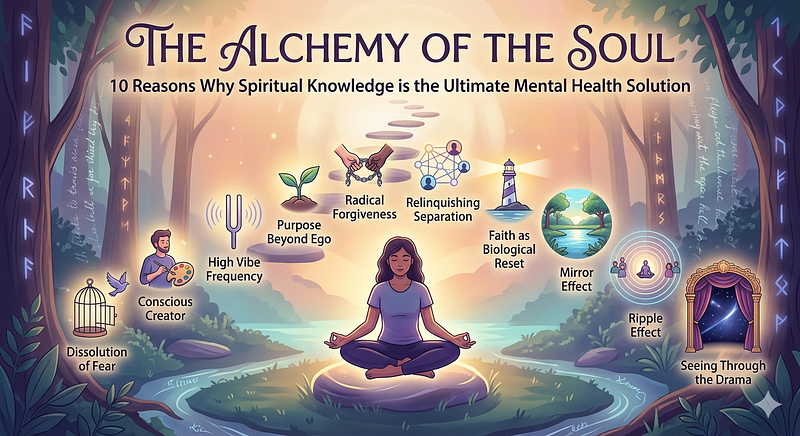
Writing about the intersection of spirituality and mental health requires a shift in perspective — moving from the “fixing” of a broken machine to the “awakening” of a powerful creator. Books like Conversations with God by Neale Donald Walsch and A Course in Miracles suggest that mental health struggles are often symptoms of a “misalignment” with our true nature.
Here are ten reasons why spiritual knowledge provides a comprehensive framework for mental well-being and life transformation.
1. The Dissolution of Fear through Divine Identity
In Conversations with God, a central theme is that there are only two core emotions: Fear and Love. Most mental health issues — anxiety, paranoia, and panic — are rooted in fear. Spiritual knowledge teaches that you are an extension of the Divine. When you realize your essence is eternal and supported by a Higher Power, the “survival” instinct of the ego begins to quiet. You move from a state of “What if something bad happens?” to “I am safe in the hands of the Universe.”
2. Shifting from Victimhood to Conscious Creator
Standard psychology often focuses on how our past or our environment has shaped us. While valid, spirituality introduces the concept of Response-ability. By understanding that you are a co-creator of your reality, you stop being a victim of circumstances. This shift in perspective provides an immediate boost in agency. As A Course in Miracles suggests, “I am responsible for what I see,” which empowers the individual to change their internal narrative to change their external experience.
3. The Power of “High Vibe” Frequency
Everything is energy. Spiritual knowledge teaches us that emotions like guilt, shame, and grief vibrate at a low frequency, while joy, peace, and love vibrate at a high frequency. By consciously choosing thoughts that “feel better,” you literally tune your brain and body to a different station. This isn’t just “positive thinking”; it is vibrational alignment. When your “vibe” is high, depressive states find it difficult to take root because the environment is no longer hospitable to them.
4. Finding Purpose Beyond the Ego
A major cause of modern depression is a sense of purposelessness — the feeling that we are just “cogs in a machine.” Spiritual knowledge reveals that your purpose is not your job or your social status, but the evolution of your soul. Understanding your relationship with God/The Universe gives every moment meaning. Even challenges become “opportunities for growth” rather than “random tragedies,” providing the mental fortitude needed to navigate life’s storms.
5. The Practice of Radical Forgiveness
A Course in Miracles posits that grievances are the primary blocks to our internal peace. Spiritual knowledge teaches that holding onto anger is like drinking poison and expecting the other person to die. By recognizing the “oneness” of all beings, forgiveness becomes a selfish act of self-liberation. Releasing the past cleanses the mental palate, removing the heavy baggage that often leads to chronic stress and emotional exhaustion.
6. Relinquishing the Illusion of Separation
Many mental health struggles stem from a profound sense of loneliness and isolation. Spirituality bridges this gap by teaching that separation is an illusion. We are all connected to the same source energy. When you truly “know” this, the existential dread of being “alone in the universe” vanishes. This sense of belonging is a powerful antidepressant that no pill can replicate.
7. Faith as a Biological Reset
While fear triggers the “fight or flight” nervous system, faith activates the parasympathetic nervous system. Adopting a stance of faith — trusting that “all things are working together for my good” — lowers cortisol levels and promotes physical healing. This isn’t blind belief; it is a psychological “letting go” that allows the mind to enter a state of flow rather than friction.
8. The Mirror Effect: Healing the Inner to Fix the Outer
One of the most profound “tricks” found in spiritual texts is the Law of Correspondence: As within, so without. Mental health treatment often focuses on changing the environment to feel better. Spiritual knowledge flips this. By becoming “rich inside” — cultivating peace, excitement, and gratitude — the external world eventually reflects that state. Relationships improve, opportunities appear, and chaos subsides, creating a feedback loop of mental wellness.
9. The Ripple Effect: Healing the Collective
As you mentioned, the benefits of spiritual knowledge extend like a pebble in a pond. When an individual achieves mental peace through spiritual understanding, they stop projecting their trauma onto others. This “Emotional Contagion” works both ways. Your calm becomes the calm of your family, your community, and eventually your geographic area. Knowing that your healing helps others provides a profound sense of altruism and worth.
10. The Ultimate Perspective: Seeing Through the “Drama”
Finally, spiritual knowledge allows us to step back and see life as a “divine play” or a “classroom.” In Conversations with God, we are reminded that we are “in the world but not of it.” This detachment isn’t about being cold; it’s about perspective. When you realize that your true self cannot be harmed by the ups and downs of the physical world, mental health problems lose their grip. You become the observer of the storm, rather than the person drowning in it.
Conclusion
By integrating these spiritual truths, we address the root cause of mental suffering rather than just managing the symptoms. It is a journey from the head to the heart — a transition that promises not just the absence of illness, but the presence of an indestructible peace.