Demystifying the Anti-Christ Loosh Harvesting and Armageddon

The Ego and the Illusion of Separation
In this speculative cosmology, the deepest source of evil is not an outside monster but the ego: a negative mental force that opposes the soul’s naturally positive orientation. The ego insists that each person is isolated, endangered, and fundamentally different from everyone else. From that belief comes selfishness, and from selfishness comes fear. Yet the central idea of this worldview is that separation is an illusion. Life is one vast self, expressed through countless individual forms. To harm another is therefore to act against a larger reality of which everyone is a part.
Some people, however, become deeply attached to self-service. They use others, condemn them, and pursue advantage without regard for the consequences. Repeated long enough, these choices are said to lower their spiritual vibration. Fear becomes easier to trigger, compassion becomes harder to access, and selfish behavior begins to feel normal. The person may still believe they are gaining power, but in this story they are actually becoming more vulnerable to forces that feed on anxiety, conflict, and despair.
The Loosh Harvest
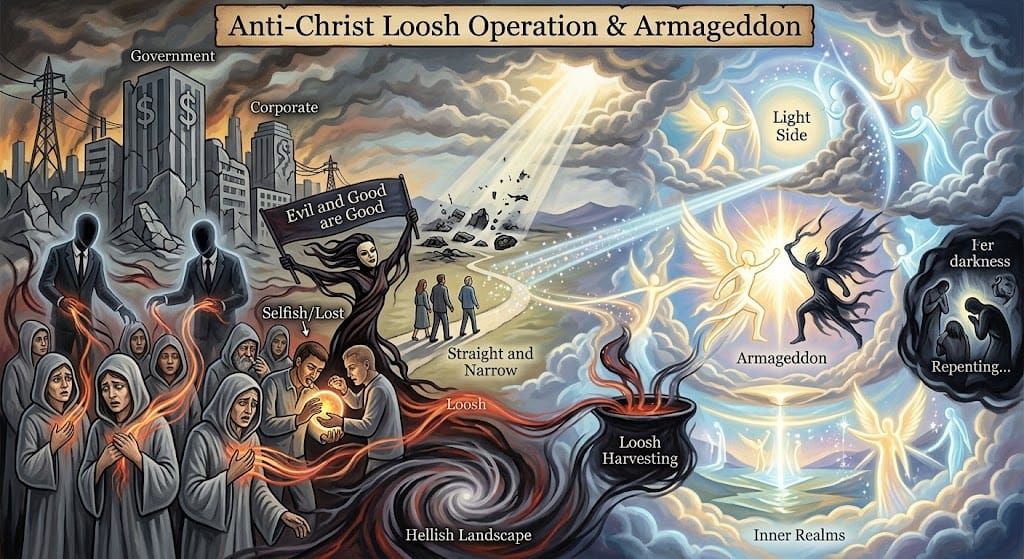
“Loosh” is the name given here to life energy—the subtle vitality generated by living beings. The dark side allegedly targets those caught in cycles of fear because fear opens cracks in the soul’s aura. Through those cracks, hostile nonphysical forces drain energy and push their targets toward even lower states. The result is a self-reinforcing loop: fear produces selfishness, selfishness produces harm, harm produces more fear, and every turn of the cycle supplies another harvest.
Behind this operation stands an anti-Christ figure—not merely as one personality, but as the organizing intelligence of a system that has worked for thousands of years. Its imagined goal is cultural capture. By spreading cruelty, confusion, and division, the system hopes to reshape Earth into a landscape where suffering is ordinary and life energy can be harvested continuously. Its agents do not understand their own divine connection. They emerge from inner layers of darkness and mistake ignorance for independence.
Agents in the Physical World
Within this mythology, both light and darkness work through physical people. Souls aligned with the light respect divine law and enter life through a natural process of incarnation. Dark forces are portrayed as ignoring that order, attempting instead to seize influence over newborn or adult bodies. Their human followers may knowingly serve destructive goals, but many simply participate in systems whose incentives reward exploitation.
Government and corporate environments become important battlegrounds because they concentrate wealth, law, and authority. The warning is not that every official, lawyer, accountant, executive, or politician serves darkness. Rather, a person moves toward the dark side whenever they treat human beings as tools for increasing power or profit. Institutional titles do not reveal spiritual allegiance; patterns of conduct do. The clearest signs are manipulation, deliberate harm, and the reduction of other lives to numbers on a ledger.
Armageddon as a Battle of Orientation
The inner realms, according to this account, are already tipping toward the light. As darkness loses shelter there, it is pushed into the open physical world, where its methods become easier to see. Exposure is dangerous to any system that depends on secrecy. Once manipulation is named, fear loses some of its power. Once exploitation is visible, people can choose whether to continue supporting it.
Armageddon, then, is not necessarily a physical war. It is a confrontation between orientations: service to the whole versus service to the isolated ego. Those who choose the “straight and narrow” enter this battle whenever they refuse cruelty, reject manipulation, forgive where they can, and act with courage instead of panic. Their struggle may take place in relationships, workplaces, communities, or within their own thoughts. Every choice either strengthens connection or deepens separation.
The Central Deception
Times of exposure create confusion. People who built their identities around selfish systems may suddenly feel lost, ashamed, or frightened. The dark side allegedly uses that instability to recruit them into cult-like groups that promise safety and hidden knowledge. The offer appears compassionate, but the real purpose is brainwashing. Its key lie is simple: good and evil are equally good.
By erasing the distinction between actions that heal and actions that harm, the group removes its followers’ moral resistance. Cruelty can be reframed as strength, deception as wisdom, and exploitation as spiritual advancement. In contrast, those who remain committed to conscience are said to receive unusual protection and unexpected blessings. Their advantage does not come from domination, but from alignment with the larger life they recognize as their true self.
Why the Dark Strategy Collapses
The dark strategy contains the seed of its own destruction. It promises that relentless selfishness will eventually produce permanent success, yet every evil act creates consequences. Betrayal makes trust impossible. Greed creates rivals. Fear demands ever greater control. A hierarchy built on exploitation cannot remain stable because its members eventually exploit one another. As the light expands on the physical level, dark factions turn inward, competing, exposing, and destroying their own alliances.
This is why chronic fear, condemnation, and unforgiveness matter so much in the story. They are not merely unpleasant emotions; they are openings through which the individual gives power away. A person obsessed with enemies can become an agent of the very darkness they oppose. Whether knowingly or not, those who feed on outrage and division help maintain the loosh operation by keeping themselves and others in a state of energetic depletion.
Beyond the Simulation
The final confusion of the dark side is mistaken identity. It believes the temporary avatar—the personality, body, title, possessions, and social position—is the whole self. The light recognizes something larger: life itself is the shared self, and individuality is one expression of a single being. From that perspective, selfish victory is impossible because no part can truly triumph by injuring the whole.
Even lost souls are not eternally lost. When they finally recognize the emptiness of evil, they can repent, return to connection, and leave the pocket of darkness created by ignorance. Armageddon ends not only through the defeat of destructive systems, but through the realization that those systems never possessed ultimate reality. In the largest frame, the conflict between light and dark is a simulation inside the universe. Beyond it, only the light exists. For entertainment purposes, this vision offers a dramatic question worth considering: if fear feeds the darkness, what might become possible when people choose courage, compassion, and unity instead?