How Ego Death Leads To The End Of Suffering & Endless Peace
The human experience is often defined by a quiet, underlying desperation — a sense that no matter what we achieve, possess, or become…

The human experience is often defined by a quiet, underlying desperation — a sense that no matter what we achieve, possess, or become, something remains missing. We spend our lives building a fortress called the “ego,” a complex structure of identity, defense mechanisms, and social masks designed to protect us from a world we perceive as separate and often hostile. However, according to the profound spiritual insights found in Conversations with God, A Course in Miracles (ACIM), and The Urantia Book, this very fortress is the source of our suffering.
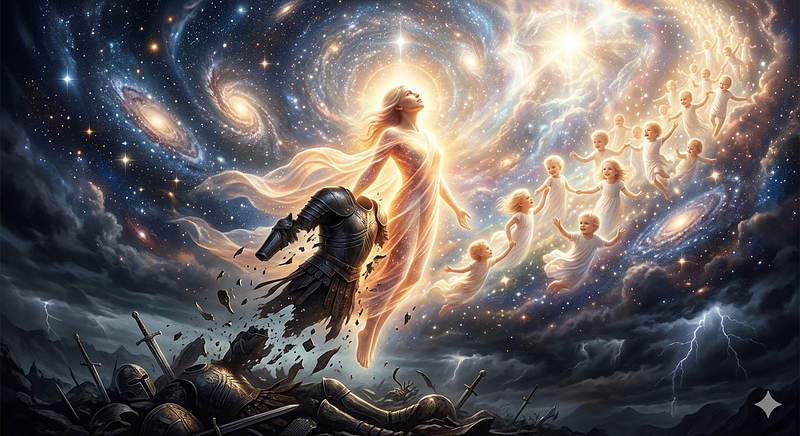
True fulfillment does not come from strengthening the ego, but from its “death” — a radical shift in consciousness where we cease identifying as a limited body and begin living as an eternal spirit. This is the essence of being “reborn,” the transition from the weary warrior to the fulfilled child of God.
The Illusion of the Warrior: Why the Ego Suffers
In the “warrior stage” of human development, life is viewed as a series of battles to be won. We fight for status, for love, for security, and for the validation of our existence. This stage is fueled entirely by the ego, which A Course in Miracles defines as a “wrong-minded” belief in separation.
The ego thrives on the idea that you are a body, confined to a specific time and place, and fundamentally disconnected from others and from God. Because the body is fragile and temporary, the ego lives in a state of perpetual fear. It views every interaction as a potential threat or a potential gain. In this state, suffering is inevitable because comparison is constant; there is always someone “better” or “more” to trigger our inadequacy. Loss is also guaranteed, since the ego identifies with things that change — youth, wealth, health — it is always mourning what has passed or fearing what will go.
In this stage, God is perceived as external. The warrior views the Divine as a distant judge or a source of power to be bargained with, rather than an internal reality. The Urantia Book describes this as the struggle of the “animal-origin” mind. We are driven by primal urges for self-preservation until we allow the “Adjuster” — the fragment of God within us — to take the lead and transform our survival instinct into spiritual insight.
Ego Death: Not the End of Life, but the End of Fear
The term “ego death” can sound terrifying, but in the context of Conversations with God, it is the ultimate liberation. It is not the literal death of the person, but the dissolution of the idea of being a separate self. Neale Donald Walsch writes that “fear is an acronym for False Evidence Appearing Real.” Ego death is simply the moment we stop believing that false evidence.
When the ego dies, the “I” that was once a collection of labels — “I am a doctor,” “I am a failure,” “I am my past mistakes” — is replaced by a singular, profound realization: I Am.
This is the shift from “doing” to “being.” In this space, suffering ends because the source of suffering — the belief in lack — has been removed. You cannot lack anything if you realize you are part of the All. As A Course in Miracles teaches: “Nothing real can be threatened. Nothing unreal exists. Herein lies the peace of God.”
Reborn in Spirit: The Teachings of Jesus Reimagined
When Jesus spoke to Nicodemus about being “reborn,” he wasn’t speaking of a physical impossibility, but a metaphysical necessity. To be reborn in spirit is to shift your primary identity from the physical vessel to the divine essence inhabiting it.
The Childlike State
Jesus famously said, “Unless you change and become like little children, you will never enter the kingdom of heaven.” Through the lens of these spiritual texts, this is not a call to ignorance, but to unlearning.
A child looks at the world without the “filters” of the ego. They do not see a “weed”; they see a flower. They do not see a “stranger”; they see a playmate. This is perception without judgment. Furthermore, it represents a total dependence on the Divine. Just as a child trusts their parents to provide, the reborn soul trusts the Universe (or God) completely. Conversations with God emphasizes that God is not a provider we must beg, but a source that is already providing everything we need the moment we align our will with Divine Will.
The End of the Body Identity
Living as spirit means recognizing the body as a communication device rather than a prison. The Urantia Book explains that our stay on Earth is merely the first stage of an eternal “ascension career.” When we stop obsessing over the body’s demands and begin focusing on our spiritual growth, we experience “endless fulfillment.” We are no longer affected by the world’s chaos because our peace is anchored in the unchanging reality of spirit.
The Shift from Effort to Grace
The transition from the warrior stage to the stage of fulfillment is a journey from “effort” to “grace.” In the warrior stage, motivation is rooted in fear and ambition. One views others as competitors or tools to be used for personal gain. However, for the spirit-led soul, motivation arises from love and inspiration. Others are seen as extensions of the self, and God is experienced as a partner in a constant, creative dance.
In the warrior stage, faith is a tool used to get what one wants. In the fulfilled stage, faith is the reward. You no longer pray for things to change; you pray because you are in a constant state of communion. You realize that, as Conversations with God suggests, you are a “co-creator” with the Divine. You aren’t here to learn lessons; you are here to remember who you truly are. While the warrior eventually faces burnout, the reborn soul experiences an eternal energy that never flags.
Relearning the World through the Holy Instant
A Course in Miracles introduces the concept of the “Holy Instant” — a moment where we step out of past regrets and future fears and enter the pure present. This is how the “reborn” soul interacts with the world.
When you see the world as a child, every moment is new. You no longer project your past traumas onto your current relationships. You relearn the world by asking, “How would Love see this?” Instead of reacting with the ego’s defensiveness, you respond with the spirit’s compassion. This is the “beginning of living” because, for the first time, you are actually present for your life. You are no longer a ghost haunting your own history or a shadow chasing a future that never arrives.
The Urantia Perspective: The Supreme Unity
The Urantia Book reminds us that this transformation is supported by the “Spirit of Truth.” We are not doing this alone. The “death” of the ego is made possible by the realization that we are part of a vast, friendly universe. We move from the “survival of the fittest” mentality of the warrior to the “service of the all” mentality of the spirit.
In this state, fulfillment is “endless” because it is not dependent on external circumstances. Whether you have much or little in the material world, your internal cup is overflowing. You have found the “Kingdom of Heaven” within, and as promised, all other things are added unto you — not as idols to be worshipped, but as tools to be used for the joy of creation. The spiritualized mind no longer searches for meaning; it is the meaning.
Conclusion: Walking the Path of Light
To die to the ego is to wake up to the Truth. It is the end of the long, exhausting war with ourselves and the world. By embracing the teachings of Conversations with God, A Course in Miracles, and The Urantia Book, we find the courage to let go of the small, fearful self.
We become the “reborn” ones — those who walk the earth but are not of it. We look at the world through the eyes of a child, seeing only the beauty, the potential, and the presence of God in every face and every flower. This is not a dream; it is the natural state of being for those who have chosen to live as Spirit. The warrior has laid down his sword, and in its place, he has found the infinite power of a peaceful heart, forever fulfilled by a faith that requires no proof, only experience.